|


introCompubeaver --> How to case mod a beaver - in 29 easy steps!
Turn a taxidermy animal into your desktop PC.
Both neat and handy!
Both neat and handy!

|


| $999.00 |


Everyscape aims to be able to show you the whole world -- both inside and out -- from its website. It plans to do this with normal 2D photos. Using proprietary technology Everyscape will stitch these photos together and 3D-ify them. The result is a pan-n-scan world accessible through a Flash viewer.

Labels: diffused illumination, touchlib
The deformable screen is made from a thin, translucent elastic fabric (e.g. spandex-based fibers - better known as Lycra). There are several ways to "scan" this surface in order to extract its depth characteristics. A rather conventional technique would rely on a 2D scanning rangefinder. After giving the problem some though, I decided to study a cheaper technique not relying on any laser scanner. In fact, a a conventional CCD camera and a special illumination configuration will suffice: using an on-axis infrared source (such as a LED ring) and a conventional CCD camera (with an IR filter), it should be possible to acquire a gray-scale image indicating, at each location in the surface, the actual inclination between the illuminating ray and the surface-normal; if both the camera and the light source are relatively far from the screen, and placed so as to share the same optical axis (see figure), then it is relatively easy to compute the actual deformation of the screen from the gray-scale map data.To enhance infrared reflectivity and disminish the eventuallity of projector hot spots, the spandex-based fabric is plastic coated on the inner side.

Click on image to lauch video [WMV- 9.4MB]
I guess most of the people reading this will have seen some of the multi-touch demos by Jeff Han, Apple and Tactiva. I wanted to play around with some ideas that required a multi-touch pad, but there aren't any devices available (Tactiva aren't shipping...)
Long story short, I made a simple one from a plastic bag, some dye and a camera:
 |
| Click here for a slide show of the mobile planetariums |
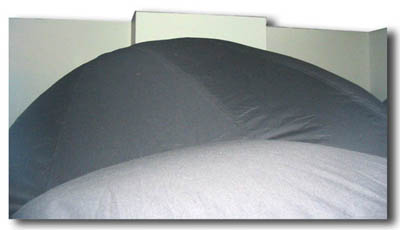
The room is suffused in shades of gray, except for a bluish computer monitor to one side. From its glow, I can make out a circle of smooth curved walls arching upward almost 3 meters and meeting in the center overhead. A fan whirrs in the otherwise quiet interior: a blower is inflating this perfect nylon dome. In the darkness, I get the illusory sense of a vacuous sanctuary.
Sanctuary until a flap opens and a man ducks in on a shaft of light, followed a gaggle of chattering sixth-graders. He invites them to find a comfortable spot, and they happily flop to their backs, sending up a mix of bubblegum perfumes and sweaty sneakers. One boy whispers, “This is cool.”
 “Hi,” says Joel Halvorson, program director for the Minnesota Planetarium Society. “What we’re inside is an inflatable dome, what we like to think of as a mobile planetarium.”
Moments later, his assistant, Sally Goff, works the laptop. She douses the lights, and giggles percolate instantly. She clicks a few more keys, lighting up a small, fish-eye-lens projector in the middle of the room, and suddenly the Earth appears directly overhead, three meters wide in all its luminous glory. A chorus of “oohs,” and a girl spontaneously reaches her hand skyward. Another click and we’re coursing to the edges of the galaxy. More “oohs.” The kids are hooked....
Affiliation: The Elumenati
Event Date: Wednesday, August 8, 2007
Location: NASA GSFC, Building 33, Room H114
Time: 12:00 PM
Absorbing the Big Picture: Immersion and Interactivity in Science Education
...new technologies too often provide little more than temporary novelty if they're not thoughtfully integrated with other pedagogical elements to create meaningful and compelling experiences.
In this lecture/presentation, David McConville will illustrate the ways in which new interactive technologies and spatially immersive displays can be utilized to more fully engage students and the public in the science education process. Applying findings from cognitive psychology, gaming theory, and experiential education research, he will demonstrate how new collaborative and socially-oriented visualization tools have the potential to enable more intuitive and self-directed learning for students, scientists, policy makers, and the public.
About Our Speaker
David McConville is a media artist and researcher focused on the development of the most compelling uses of immersive virtual environment displays. He is the co-founder and Director of Noospheric Research of The Elumenati,
Off Site Access
This talk will be Webcast at: http://mediaman.gsfc.nasa.gov/asx/Public/Live/Building33Live.asx
NOTE: You will need to have Microsoft MediaPlayer installed to view this Webcast. Alternatively, folks may tune in via telephone for audio only by dialing 1-866-819-9680; passcode = 990261.
List of links, information and technologies associated with this project.
Related Projects
Software
Hardware
| Goals The Dome and ProjectorWe have a 5 meter inflatable dome. Inside, in the center, there is a modified Epson PowerLite 715c projector fitted with an Elumens lens for spherical projection.
| Technology |

Shown below VRs taken during the conference. They may not be in chronological order, because some people are faster to stitch and upload than others. You can also browse the VRs by equipment used, by location, by day and by photographer.
Click the thumbnail to view the interactive VR, or click the title or 'read more' for more information about the VR.

 Piazza San Marco, Venice


 |
One of the biggest challenges to “mobile computing” (besides battery life) is outdoor readability. (If you’ve ever squinted through your sunglasses trying to dial on your windows mobile phone, you know what I’m talking about).
Recently I had an old EO 72xx UMPC upgraded to a transflective screen by Advanced Link Photonics. It cost a few hundred dollars for them to treat the LCD with some sort of new surface and then replace the touch panel with another type with some sort of glare reduction. I then brought up google maps on both units and took them outside to get a comparative.
In the picture you can see the top, washed out picture is the normal LCD, and the bottom picture is the transflectivized unit.

transflective unit in sunlight

Steven also spoke about his book The Ghost Map and how it inspired Outside.in. The book covers the infamous cholera outbreak of London in the 19th century. The outbreak was stopped by two men (Whitehead and Snow) who used their social network to create a map of the cholera deaths. Through this work they identified an infected water pump and saved many lives. If you want to learn more quickly here's a video of Steven talking about Ghost Map.
Snow and Whitehead would not have been able to actually solve the mystery if the following circumstances hadn't occurred:


 Posts
All Comments
Posts
All Comments