Wednesday, April 01, 2009

ACM Creativity & Cognition 2009

ACM Creativity & Cognition 2009:
Everyday Creativity
sidepiece.gif
ACM Creativity & Cognition 2009

Creativity
ACM 2009

Keynote Speakers: Mihály Csíkszentmihályi & JoAnn Kuchera-Morin
Everyday Creativity: Shared Languages & Collective Action, October 27-30 2009 Berkeley Art Museum & UC Berkeley

CREATIVITY IS PRESENT IN ALL WE DO
The 7th Creativity and Cognition Conference (CC09) embraces the broad theme of Everyday Creativity. This year the conference will be held at the Berkeley Art Museum (CA, USA), and asks: How do we enable everyone to enjoy their creative potential? How do our creative activities differ? What do they have in common? What languages can we use to talk to each other? How do shared languages support collective action? How can we incubate innovation? How do we enrich the creative experience? What encourages participation in everyday creativity?

KEYNOTE SPEAKERS
Mihály Csíkszentmihályi Professor of Psychology & Management
Claremont Graduate University [California, USA]

JoAnn Kuchera-Morin Director, Allosphere Research Laboratory
Nanosystems Institute [California, USA]


Jane Prophet Professor of Interdisciplinary Computing
Goldsmiths University of London [London, UK]


CONFERENCE THEMES AND TOPICS
The Creativity and Cognition Conference series started in 1993 and is sponsored by ACM SIGCHI. The conference provides a forum for lively interdisciplinary debate exploring methods and tools to support creativity at the intersection of art and technology. We welcome submissions from academics and practitioners, makers and scientists, artists and theoreticians.

This year’s broad theme of Everyday Creativity reflects the new forms of creativity emerging in everyday life, and includes topics of:

* Collective creativity and creative communities
* Shared languages and participatory creativity
* Incubating creativity and supporting Innovation
* DIY and folk creativity
* Democratising creativity
* New materials for creativity
* Enriching the collaborative experience

We welcome the following forms of submission:

* Empirical evaluations by quantitative and qualitative methods
* In-depth case studies and ethnographic analyses
* Reflective and theoretical accounts of individual and collaborative practice
* Principles of interaction design and requirements for creativity support tools
* Educational and training methods
* Interdisciplinary methods, and models of creativity and collaboration
* Analyses of the role of technology in supporting everyday creativity

SUBMISSION DEADLINE
24 April 2009

PROCEEDINGS
All submissions will be peer reviewed. Printed proceedings, published by ACM Press, will be available at the conference and will be included in the ACM digital library.

PROMOTIONAL POSTER
Download our promotional poster (pdf)


ACM 2009
Reblog this post [with Zemanta]

The Museum of Modern Art Enhances Its Web Site - NYTimes.com

The Museum of Modern Art Enhances Its Web Site - NYTimes.com

The 30-second Video on this page is priceless.

In many ways MoMA, which has never had an ongoing blog, is catching up to a museum world that has been finding many ways to attract and share information with art lovers who may never set foot in the museums. The Brooklyn Museum, for example, which has maintained lively blogs since the summer of 2006, provides a detailed stream of traveloguelike pictures and words to keep viewers current on the progress of its archaeological work in Egypt (brooklynmuseum.org).

For the last two years MoMA has been branching out energetically elsewhere on the Web, creating a YouTube channel, a Facebook page, a Twitter feed (something the Metropolitan Museum of Art and many other museums also maintain) and a Flickr group, where museum visitors can upload their pictures, some of which will end up on the museum’s Web pages. The new site includes an area called MoMA Voices that Ms. Burnette and Steven Peltzman, the museum’s chief information officer, see as a place where blogs will begin to form and where new ideas about how to have conversations will grow organically.

Museum visitors with cellphones will be able to text the number associated with an artwork to an area on the museum’s Web site. In this way they can later review and organize what they have seen. Mr. Peltzman and Ms. Burnette said that they hoped one day to allow site visitors to search for works on display simply by zooming in on three-dimensional maps.

Monday, March 30, 2009

loc.alize.us

http://loc.alize.us/#/user:Jon%20Schull/geo:43.165123,-78.112793,2,h/sort:date/

Flickr: Help: The Map

Flickr: Help: The Map

http://www.flickr.com/map/

How do I add my photos to a map?

It's easy! To geotag a photo just click "Add to your map" on the photo page (over on the right ;).

To work with more than one image you can open up the Organizr Map and drag photos from the Findr bar at the bottom, to the location where you took the photos.

There's more information about how to geotag your photos in the Organizr FAQs.

 
Posted by Picasa

Facebook | IDEO’s Ten Tips For Creating a 21st–Century Classroom Experience

IDEO’s Ten Tips For Creating a 21st–Century Classroom Experience

21st–Century Classroom Experience

Posted February 18, 2009

In recent years, IDEO has spent a lot of time and effort thinking about education. The firm’s work with Ormondale Elementary School, in Portola Valley, California, helped pioneer a special “investigative-learning” curriculum that inspires students to be seekers of knowledge. We spoke to Sandy Speicher, who heads the Design for Learning efforts at IDEO. Her insights provide powerful lessons for architects and designers creating the schools of tomorrow:

1. Pull, don’t push.
Create an environment that raises a lot of questions from each of your students, and help them translate that into insight and understanding. Educa­tion is too often seen as the transmission of knowledge. Real learning happens when the student feels the need to reconcile a question he or she is facing—and can’t help but seek out an answer.

2. Create from relevance.
Engage kids in ways that have relevance to them, and you’ll capture their attention and imagination. Allow them to experience the concepts you’re teaching firsthand, and then discuss them (or, better yet, work to address them!) instead of relying on explanation alone.

3. Stop calling them “soft” skills.
Talents such as creativity, collaboration, communication, empathy, and adaptability are not just nice to have; they’re the core capabilities of a 21st-century global economy facing complex challenges.

4. Allow for variation.
Evolve past a one- size-fits-all mentality and permit mass customization, both in the system and the classroom. Too often, equality in education is treated as sameness. The truth is that everyone is starting from a different place and going to a different place.

5. No more sage onstage.
Engaged learning can’t always happen in neat rows. People need to get their hands dirty. They need to feel, experience, and build. In this interactive environment, the role of the teacher is transformed from the expert telling people the answer to an enabler of learning. Step away from the front of the room and find a place to engage with your learners as the “guide on the side.”

6. Teachers are designers.
Let them create. Build an environment where your teachers are actively engaged in learning by doing. Shift the conversation from prescriptive rules to permissive guidance. Even though the resulting environment may be more complicated to manage, the teachers will produce amazing results.

7. Build a learning community.
Learning doesn’t happen in the child’s mind alone. It happens through the social interactions with other kids and teachers, parents, the community, and the world at large. It really does take a village. Schools should find new ways to engage parents and build local and national partnerships. This doesn’t just benefit the child—it brings new resources and knowledge to your institution.

8. Be an anthropologist, not an archaeologist.
An archaeologist seeks to understand the past by investigating its relics and digging for the truth of what was. An anthropologist studies people to understand their values, needs, and desires. If you want to design new solutions for the future, you have to understand what people care about and design for that. Don’t dig for the answer—connect.

9. Incubate the future.
What if our K–12 schools took on the big challenges that we’re facing today? Allow children to see their role in creating this world by studying and creating for topics like global warming, transportation, waste management, health care, poverty, and even education. It’s not about finding the right answer. It’s about being in a place where we learn ambition, involvement, responsibility, not to mention science, math, and literature.

10. Change the discourse.
If you want to drive new behavior, you have to measure new things. Skills such as creativity and collaboration can’t be measured on a bubble chart. We need to create new assessments that help us understand and talk about the developmental progress of 21st-century skills. This is not just about measuring outcomes, but also measuring process. We need formative assessments that are just as important as numeric ones. And here’s the trick: we can’t just have the measures. We actually have to value them.

Monday, March 23, 2009

Patti Maes: wearable projectors

Warehouse - Subversion Browser

Warehouse - Subversion Browser
Bookmark added by Janos Haits at 02:27 AM CST
Warehouse is a web-based subversion browser with a beautifuly simple design that lets you manage your subversion repositories and permissions on the web.

Sunday, March 15, 2009

Bridge Over The River Quoi?: 7.5-Tonne Bridge Made of Cardboard Tubes

Bridge Over The River Quoi?: 7.5-Tonne Bridge Made of Cardboard Tubes
A temporary bridge made of 281 cardboard tubes has been erected over a river in Southern France. Weighing 7.5 tonnes, it can hold up to 20 people at a time. It is just half a mile from the Pont du Gard, an old Roman stone bridge, and was designed by Shigeru Ban, a Japanese architect known for his both grandiose and humble paper constructions, as you can see in the gallery. The technical details make it even more stunning.


Shigeru Ban

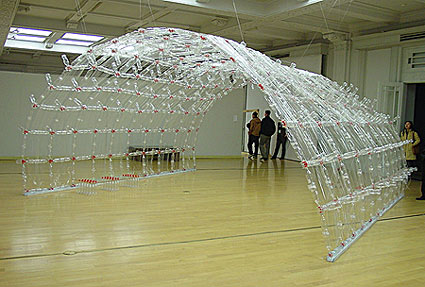
Plastic Bottle Structure, 01, 2002. Plastic bottles, acrylic, plastic wrap, nylon wire

http://www.universes-in-universe.de/car/shanghai/2002/tour/e-tour-16.htm


japan pavilion, hanover expo, 2000, shigeru ban and frei otto
the largest cardboard structure built to date
www.designboom.com/history/aalto/models.html

Saturday, March 14, 2009

The Ideocultural Age


I (Jon) think this is the next thing: creation of semi-autonomous systems that go on to propagate ideas "on their own".

Daniel Pink argues that society, having moved through the Agricultural and Industrial ages is now transitioning from the Information Age to the Conceptual Age in which creative and empathetic skills will be as valuable as technological skills (and the ability to combine them will be most precious).

But perhaps we can see a bit further. The idea of the “meme” has moved from speculative biology to common parlance in the last 25 years, aided and abetted by a growing global network of computer viruses, digital media, viral marketers, and internet-enabled ideologies. New kinds of products based upon artificial life (computational, chemical, and nano-mechanical), engineered genomes and technologies for augmenting nervous systems are coming to market. The “marketplace of ideas” is recognizing the phrase “ecology of ideas,” as a complementary and perhaps more fertile metaphor for the coming era.

I would suggest that future innovators will influence the ecology of ideas by focusing not just on the extraction of material resources from the physical world, not just on the cultivation of existing plant and animal species, not just on conceptual synthesis of ideas and experiences, but on the design and creation of self-regenerating patterns of interaction in physical, informational, and cultural ecologies to create semi-autonomous systems that go on to propagate themselves.

That will be the Ideocultural Age.


Reblog this post [with Zemanta]

Sunday, March 08, 2009

Home - smtp2web

smtp2web

Home | Demo | About

smtp2web is a service that facilitates receiving emails in web applications such as those built on Google App Engine. It does this by accepting email for an address or domain, and uploading those emails to your application in POST requests to a URL you provide.

smtp2web allows you to register either a single @smtp2web.com email address, or have your entire domain proxied through the service.

Getting Started - ruby-processing - GitHub

Getting Started - ruby-processing - GitHub

Making Your Own

Because every sketch has a setup method, called once at the start, and a draw method, called continuously as it animates; Ruby-Processing includes a sketch creator to get you started on the right foot with the proper (minimal) boilerplate. Using rp5 create my_sketch 800 600, will generate a Processing::App that’s 800 by 600 pixels in size, and just displays a blank window. The generated my_sketch.rb will look like:

require 'ruby-processing'

class MySketch < Processing::App

def setup

end

def draw

end

end

MySketch.new :title => "My Sketch", :width => 800, :height => 600

Create Digital Motion » GSVideo GStreamer Video Library for Processing: Cure for Live Video Ills?

Create Digital Motion » GSVideo GStreamer Video Library for Processing: Cure for Live Video Ills?:

"Andrés Colubri’s library GSVideo seems to be the best answer for that moment. It’s designed to act just like the internal video library in Processing, so the syntax and operation is absurdly easy. But it relies on libraries that actually work. And best of all, you can couple it with his GLGraphics library to keep processing on the GPU for higher performance. (There are even HD video playback examples in the latter that connect to the GSVideo library.)"

Tuesday, March 03, 2009

DESIGN 21: Competitions

DESIGN 21: Competitions
Rusay_2_550x550_

éL is a Product that can be implemented by city governments utilizing existing electric service poles or new structural poles when needed. eL is lighter and quicker than new wood or concrete bridge construction. Parts are rotationally molded from 100% recycled Polyethelye (LDPE) overmolded on recycled aluminum struts for support.

DESIGN 21: Competitions

DESIGN 21: Competitions
Bike_to_bike-06h_550x550_Bike_to_bike-06f_550x550_

My device includes two connecting bars that clamp onto the frames of two bicycles and stabilize and space them apart, making the two bikes operate as a single four-wheel vehicle. A supporting platform made from either wood or lightweight aluminum tubing is connected to the upper connecting bar and stabilized by the lower one, thereby creating a functional very accessible supporting platform that can be used to carry supplies.

My device can be made using simple materials and may accommodate bicycles that are not exactly the same size or type. In its simplest form, bikes secured together using my device can operated without a linking steering mechanism, but by securing the handlebars of both bikes together, a single user can ride either bike and steer the vehicle as if it were a pickup truck.

Sunday, March 01, 2009

Simple elixir called a 'miracle liquid' - Los Angeles Times

Simple elixir called a 'miracle liquid' - Los Angeles Times
It's a kitchen degreaser. It's a window cleaner. It kills athlete's foot. Oh, and you can drink it.


Sounds like the old "Saturday Night Live" gag for Shimmer, the faux floor polish plugged by Gilda Radner. But the elixir is real. It has been approved by U.S. regulators. And it's starting to replace the toxic chemicals Americans use at home and on the job.

The stuff is a simple mixture of table salt and tap water whose ions have been scrambled with an electric current. Researchers have dubbed it electrolyzed water -- hardly as catchy as Mr. Clean. But at the Sheraton Delfina in Santa Monica, some hotel workers are calling it el liquido milagroso -- the miracle liquid.

That's as good a name as any for a substance that scientists say is powerful enough to kill anthrax spores without harming people or the environment.

Lost world of extremophiles hides beneath Great Lakes - image 2 - environment - 27 February 2009 - New Scientist

Lost world of extremophiles hides beneath Great Lakes

Just 20 metres beneath the surface of some of the largest freshwater reservoirs on Earth are deep brine-filled pockets that support unusual colonies of life

A 'finger' of velvety purple microbes was collected from the Middle Island Sinkhole (Image: Thunder Bay Sinkholes 2008)

Full size image

A diver sets up a respiration chamber experiment near the purple microbial mats at Middle Island Sinkhole in Lake Huron (Image: Tane Casserley, NOAA) A 'finger' of velvety purple microbes was collected from the Middle Island Sinkhole (Image: Thunder Bay Sinkholes 2008) The shallow Middle Island sinkhole can be seen from the surface; a 9-metre boat provides the scale of the hole (Image: Scott Kendall and Bopi Biddanda, Grand Valley State University) Groundwater filters through the nearby geology, drawing its minerals through the sinkhole at the bottom of the lake (Image: Thunder Bay Sinkholes 2008)

Official Google SketchUp Blog: 3D printing from SketchUp with CADspan: Now even better

Official Google SketchUp Blog: 3D printing from SketchUp with CADspan: Now even better

TimesPeople
The New York Times
March 1, 2009
Noah Berger for The New York Times

A defender of consistency in design, Marissa Mayer stands guard over the look and feel of Google’s search engine.


I like the combined message of this photo and caption, but this entire article should be read by everyone by all, for its demonstration of the importance of design sense, design thinking, word choice people skills, joie de vivre--everything that makes technology actually work.

Tuesday, February 24, 2009

Energy Information

Google.org SmartPower Energy Information Project


"By monitoring my energy use, I figured out that the bulk of my electricity was caused by my two 20-year-old fridges, my incandescent lights and my pool pump, which was set to run more than necessary. By replacing the refrigerators with new energy-efficient models, the lights with CFLs and setting the pool pump to only run at specified intervals, I've saved $3,000 in the past year and I am on track to save even more this year! "
Russ, Hardware Engineer
"I don't own a toaster and because I live by myself, I've always used my standard electric oven to toast bread. After seeing the power spikes from my sunday breakfasts, I did a little research on the power required to toast bread using a toaster compared to an electric oven and found that toasting bread in an oven uses 33 times as much energy as a typical toaster! With this savings, I realized that I would save money (not to mention time) by buying a toaster."
Don, Software Engineer

Wednesday, February 18, 2009

Orbited – Networking for the Web

Orbited – Networking for the Web

Orbited provides a pure JavaScript/HTML socket in the browser. It is a web router and firewall that allows you to integrate web applications with arbitrary back-end systems. You can implement any network protocol in the browser—without resorting to plugins.

Integration

Orbited ships with support for many protocols out of the box, including IRC, XMPP, and STOMP (ActiveMQ, RabbitMQ)

Scalability

Orbited’s shared-nothing architecture supports arbitrarily large server clusters—perfect horizontal scalability.

Usability

Orbited works in all browsers, cross-port and cross-subdomain, with no loading bars, clicks, or spurious history entries.

Standards

Orbited uses only web standards to provide the most future-proof API and implementation.


Sunday, February 15, 2009

Going to Art and Code

flying in, but would love to drive back East to Rochester with someone

Sunday, February 08, 2009

InformIT: Building the Ultimate Virtual Lab for Free, for Fun, and for Profit, Part 1 > Why Virtual, and Why ESXi?

InformIT: Building the Ultimate Virtual Lab for Free, for Fun, and for Profit, Part 1 > Why Virtual, and Why ESXi?

What can save you countless hours and dollars, and is even good for the environment? A free virtual lab that consolidates the hardware and power requirements of numerous systems into a single machine! In this two-part series, Seth Fogie gives you all the info you need to set up and build your own virtual lab — for free, with much fun, and potentially for profit.

Saturday, February 07, 2009

San Francisco to Get Bike-Sharing Pilot Program in 2009 : TreeHugger

San Francisco to Get Bike-Sharing Pilot Program in 2009 : TreeHugger:

San Francisco to Get Bike-Sharing Pilot Program in 2009

by Michael Graham Richard, Gatineau, Canada on 01.30.09
Cars & Transportation (bikes)
Buzz up!

gavin newsom san francisco mayor biking photo

Good News for San Francisco Commuters
While visiting Paris, a city with a quite successful bike-sharing program, San Francisco mayor Gavin Newsom announced that his city would get a bike-sharing pilot program in 2009.

Planning for Bikes Pays Off Big in Portland : TreeHugger

Planning for Bikes Pays Off Big in Portland : TreeHugger: "according to this video and accompanying article, a nascent industry has developed in Portland around bike usage. The city currently has 125 bike-related businesses, mostly small and locally-owned, covering everything from repair and custom bike building to accessories and consulting. And it is a growing industry.

The catalyst for all of this economic growth was a decision by the city to invest in designing the city for bikes. Officials say they have spent some $20 to $25 million on bicycle infrastructure over the past few years, and have plans to spend another $24 million to significantly expand Portland's bicycle network. The city also supports local bike-oriented businesses. If this seems like a lot of money to be spending on bikes, consider that an average highway interchange costs between $10 and $15 million, not including planning costs and the cost of buying up the land on which to build.

Bike-friendly planning creates many opportunities, and not just economic. Local artists have been given the chance to design unique symbols for bike lanes, giving a human touch to the traffic markings. Check out this article on the artists; here a some examples of their work."

What is ImmobiTag? :: ImmobiTag :: Protect your bike for life from being stolen with ImmobiTag

What is ImmobiTag? :: ImmobiTag :: Protect your bike for life from being stolen with ImmobiTag

The Tag

The tag emits a unique Radio Frequency Identification number that is registered online during activation of the tag.

How does electronic bike tagging work?

You Shall Have Bike Lanes Wherever You Go : TreeHugger

You Shall Have Bike Lanes Wherever You Go : TreeHuggerturn-lights jacket imagespeed imagebikelane projector image

Weatherization Stimulus: Lots of It, Fast - BusinessWeek

Weatherization Stimulus: Lots of It, Fast - BusinessWeek: "According to the DOE Weatherization Program, $1 invested returns $1.65 in energy-related benefits, and at the same time leverages $1.54 in other resources from private funding, utilities, state funds, and other federal funds. A home that's weatherized at a cost of several thousand dollars can save some $350 per year on energy bills, claims the Obama Administration. (The Weatherization Program's estimate comes in at about $413.)

For low-income families, such savings could be crucial. According to an Oak Ridge National Laboratory study, low-income families paid 17% of their annual income on energy, compared with the 4% spent by higher-income households."

Katie Couric Disses Energy-Saving Weatherization As Embarrassing : TreeHugger

Katie Couric Disses Energy-Saving Weatherization As Embarrassing : TreeHugger

...Yet they and nearly all the rest of us can save money by weatherizing, even if we get someone else to perform the service and pay directly out of pocket. Obama's response to Couric implied that weatherization, instead of being an embarrassing pork product, is actually a 'threefer':
Obama: Well, let's think about it. We're going to weatherize homes, that immediately puts people back to work and we're going to train people who are out of work, including young people, to do the weatherization. As a consequence of weatherization, our energy bills go down and we reduce our dependence on foreign oil. What would be a more effective stimulus package than that? I mean, you're getting a threefer. Not only are you immediately putting people back to work but you're also saving families on your energy bills and you're laying the groundwork for long term energy independence. That's exactly the kind of program that we should be funding.

Monday, February 02, 2009

VMware ThinApp (formerly Thinstall), Application Virtualization for IT Directors, Developers, ISV - VMware

VMware ThinApp (formerly Thinstall), Application Virtualization for IT Directors, Developers, ISV - VMware


Key Benefits for Developers:

  • Package your applications in standard EXE and MSI files
  • Deliver a zero-footprint application that doesn’t need an install
  • Convert traditional applications to virtualized applications quickly and easily
  • Streamline your regression testing with sandboxing and snapshot capabilities
  • Package or link any runtime you want directly with your application
  • Eliminate risks and conflicts with other applications on the endpoint

Miller Dowel Company | Using the Miller Dowel | View Our Demo

Miller Dowel Company | Using the Miller Dowel |

Originally designed as an alternative to nails and screws in decks and dock construction, the Miller Dowel is now major news for anyone doing wood furniture or building cabinets and mill work or creating wood products of any kind.
View the Miller Dowel Demo